Portal Chat

Website AI chat and public-information research

Turn public content
into ready-to-use
AI chat.

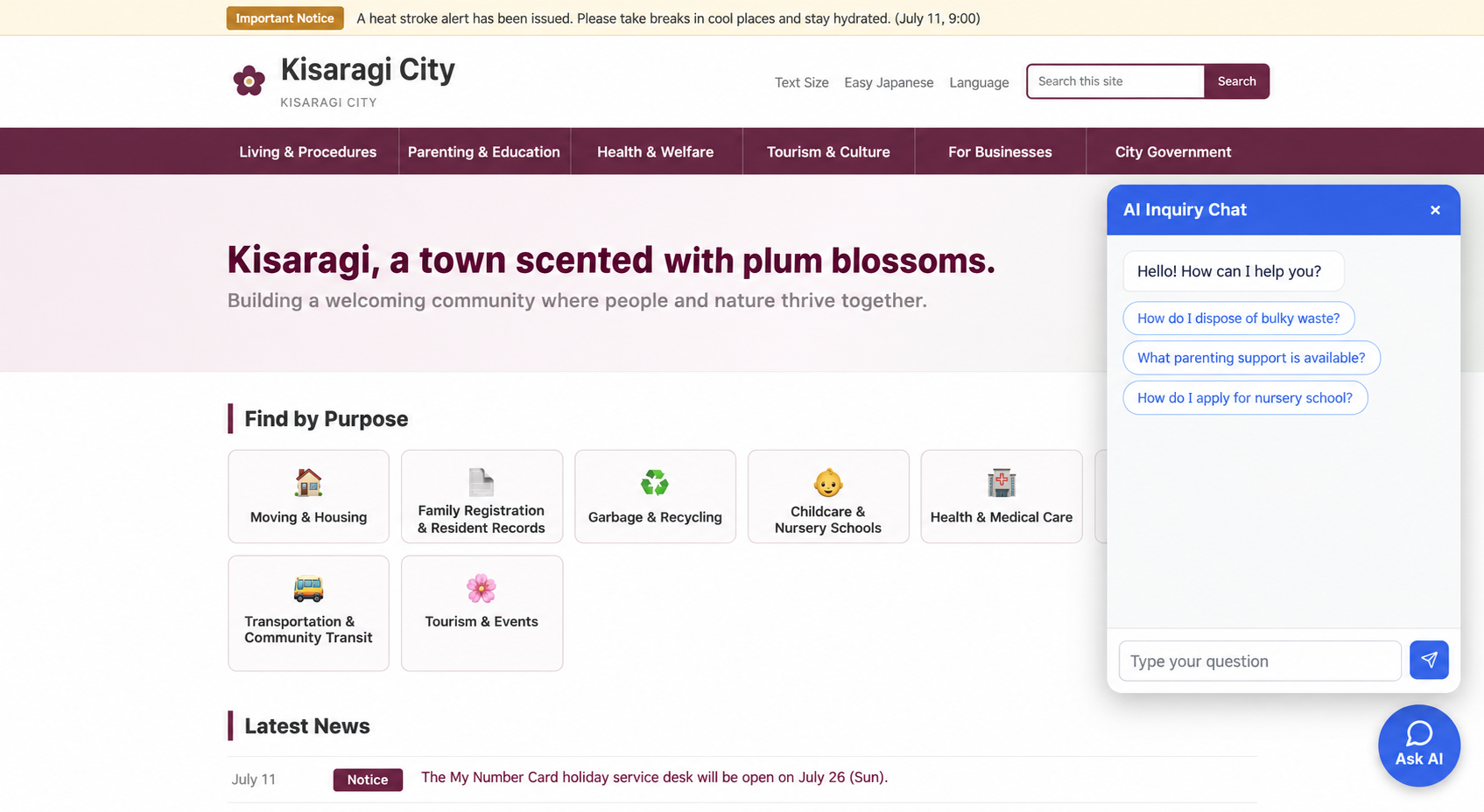
Portal Chat displayed in the lower-right corner of a website
<script src=".../widget.js" async></script>

USE CASES

Two ways to use Portal Chat,tailored to your needs.

FOR LOCAL GOVERNMENT

Make services and procedures
easier for residents to ask about.

Import public government and municipal websites to answer questions about services and procedures with links to the source pages.

  • Use public website content as the basis for answers
  • Find the information you need through natural questions
  • Return to the original page from an answer to verify the details
Explore local government use

FOR CONSTRUCTION

Research ordinances
across municipalities.

Help construction companies and architecture firms research ordinances, guidelines, and filing requirements that vary by municipality, based on project location, intended use, and other details.

  • Search municipal websites across the project area
  • Ask questions to identify relevant conditions
  • Verify the original text and responsible department on source pages
Explore construction use

This does not automate legal interpretation or decisions about ordinances and regulations. Always check the latest original rules and consult the responsible authority before making a final decision.

PRODUCT PROMISE

Keep your existing website.Ask and verify sources in one view.

01

Install with one line

Add a script tag to existing HTML to display a self-contained AI chat interface.

02

Answer from public information

Search crawled public pages for information relevant to each question.

03

Check the evidence

Answers and source pages are shown separately, so users can verify the information on the spot.

VISITOR EXPERIENCE

An easier experience,
with six practical features.

01

Suggested questions

Configure up to six questions per site to help users get started.

02

Streaming answers

Answers appear progressively through SSE, reducing the sense of waiting.

03

Reference pages

Source-page titles and URLs are displayed separately from the answer.

04

Follow-up conversations

Ask follow-up questions using the latest 20 history entries for context.

05

Switch topics

Reset the history to start another question with a fresh search context.

06

Readable answers

Display Markdown, tables, code, and links, with support for smartphones.

KNOWLEDGE & ANSWER PIPELINE

Import public pages.
Connect them to search and answers.

How public pages become knowledge

  1. 01Register target URLs

    Set a name, URL, crawl depth, and maximum page count

  2. 02Crawl

    Respect robots.txt, sitemaps, and Crawl-delay

  3. 03Extract content

    Retrieve and store titles, body text, and links

  4. 04Make it searchable

    Organize the captured information so AI can find it

  5. 05Store search data

    Save the organized information ready for search

The crawler is designed for large sites, with progress stored in a database-backed frontier so interrupted crawls can resume.

How questions become answers with sources

  1. 01Question and history

    Combine questions in the conversation to form a search query

  2. 02Find relevant information

    Search the imported pages for information related to the question

  3. 03Generate an answer

    Pass the retrieved context to an LLM to generate a response

  4. 04Answer and sources

    Return the SSE answer and source pages separately

If retrieval does not work well, the chat continues using available information or switches to a response that takes safety into account.

ADMINISTRATION & OPERATIONS

From adding sites to improving operations,
manage it in one console.

01

Register and edit sites

Manage display names, URLs, crawl depth, and maximum page counts.

02

Monitor crawling and learning

See running, completed, and failed jobs along with error details in one list.

03

Review captured pages

Track titles, URLs, depth, HTTP status, and retrieval timestamps.

01

Question management

Review questions from both the widget and registered users, with details by question, source, user, and date.

02

Conversation history

Save conversation lists and message details to revisit multi-turn exchanges later.

03

User management

Add or remove administrators and regular users, change roles, and manage usage status.

FAQ

Questions to help you
choose Portal Chat.

Explore suitable uses, pre-launch checks, and the decisions that still need human judgment.

What websites and workflows is it suited to?

It suits websites with public pages such as product information, services, procedures, and FAQs, where users need to move from an answer to its source. It can also support initial research across multiple public websites.

What do you check before deployment?

We define the target URLs and crawl scope, then check answers and source pages using expected questions. Before launch, we also verify the widget display, allowed origins, captured pages, and crawl status in the admin console.

What do I need to add AI chat to a website?

Register the target site and crawl scope, import the public content, and add one widget.js script tag to your existing HTML. Check answers, sources, and allowed origins before publishing.

Can it help research municipal ordinances?

It can find relevant information on registered public pages, such as official municipal websites, and show answers with source pages. Verify applicability and legal interpretation against the latest original text and with the responsible authority.

How can construction companies use it for ordinance research?

Use municipal building and development pages relevant to a planned site for initial research into potentially applicable ordinances, guidelines, application instructions, and consultation contacts.

Can I check the evidence used in an AI answer?

Source-page titles and URLs are shown separately from the answer. Users can open the original source to check its content and update date.

How are costs and deployment timelines determined?

We provide individual guidance after reviewing target sites, page scope, intended use, evaluation questions, and post-launch operational requirements. Include your target URLs and intended use case when contacting us.
IMPLEMENTATION

Get started
in four steps.

  1. 01Register your site

    Set a name, URL, crawl depth, and maximum page count

  2. 02Crawl and learn

    Retrieve public pages and organize them for AI search

  3. 03Add one line

    Add the widget.js script tag to existing HTML

  4. 04Review and publish

    Check CORS origins, answers, and sources before launch

CONTACT

Talk to us about
implementation and evaluation.

Contact us