Search across municipalities
Search municipal websites across the project's geographical area together.
For construction and architecture firms | Public-information AI search
Research ordinances and guidelines,
with sources.
FOR CONSTRUCTION
Search municipal websites across the project's geographical area together.
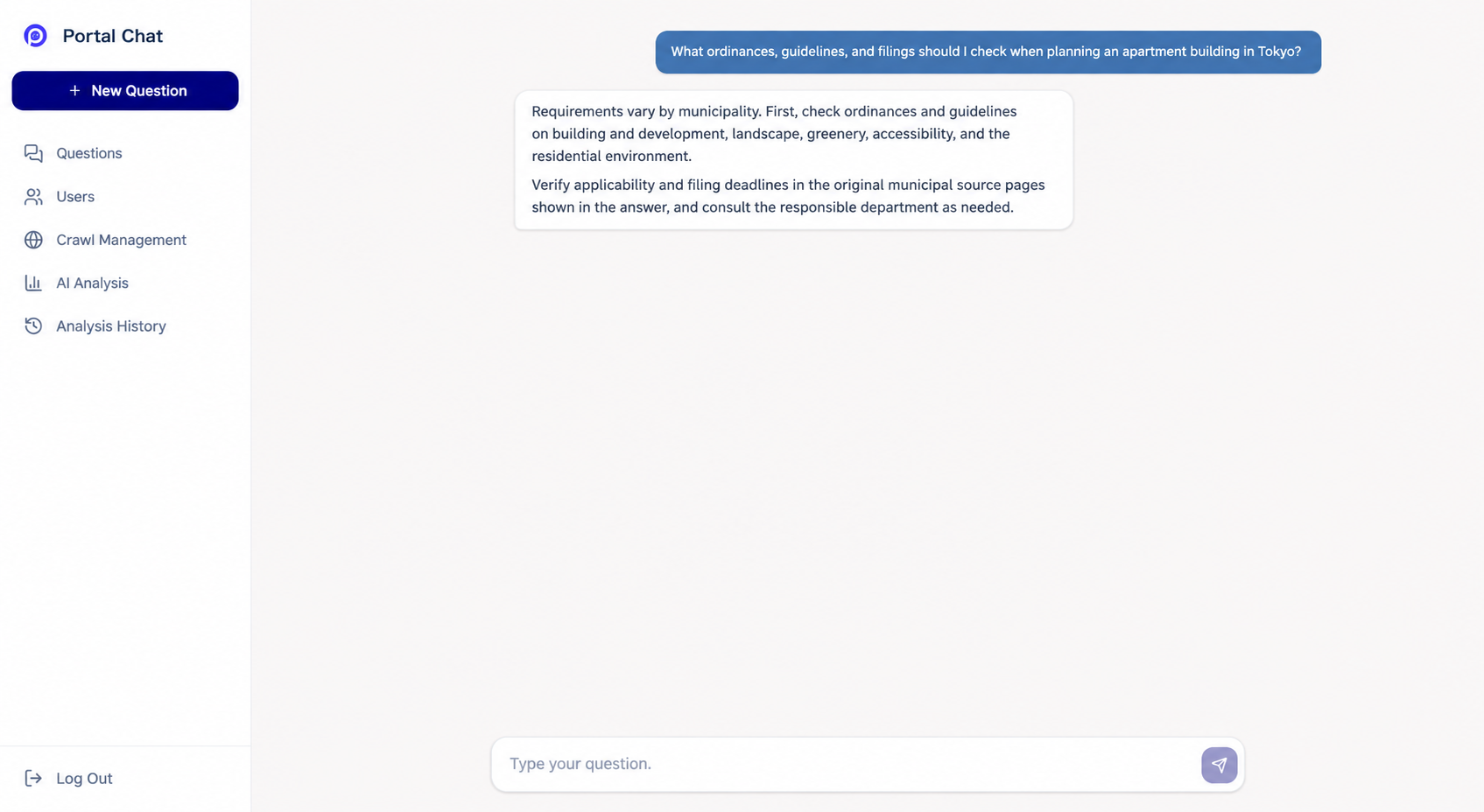
Enter the project location or intended use to find related ordinances, guidelines, and filing requirements.
Check applicability conditions and responsible departments through source pages.
RESEARCH FLOW
Select municipal websites relevant to the project area
Organize public ordinance and guideline pages for search
Register research staff so they can search by asking questions
Check answers and their sources
VISITOR EXPERIENCE
Answers appear progressively through SSE, reducing the sense of waiting.
Source-page titles and URLs are displayed separately from the answer.
Display Markdown, tables, code, and links, with support for smartphones.
KNOWLEDGE & ANSWER PIPELINE
Set a name, URL, crawl depth, and maximum page count
Respect robots.txt, sitemaps, and Crawl-delay
Retrieve and store titles, body text, and links
Organize the captured information so AI can find it
Save the organized information ready for search
The crawler is designed for large sites, saving progress in the database so interrupted crawls can resume.
Combine questions in the conversation to form a search query
Search the imported pages for information related to the question
Pass the retrieved context to an LLM to generate a response
Return answers and source pages separately
If retrieval does not work well, the chat continues using available information or switches to a response that takes safety into account.
ADMINISTRATION & OPERATIONS
Manage display names, URLs, crawl depth, and maximum page counts.
See running, completed, and failed jobs along with error details in one list.
Track titles, URLs, depth, HTTP status, and retrieval timestamps.
Review questions from registered users, with details by question, source, user, and date.
Save conversation lists and message details to revisit multi-turn exchanges later.
Add or remove administrators and regular users, change roles, and manage usage status.
IMPLEMENTATION
Set a name, URL, crawl depth, and maximum page count
Retrieve public pages and organize them for AI search
CONTACT